Thai Yoga Therapy
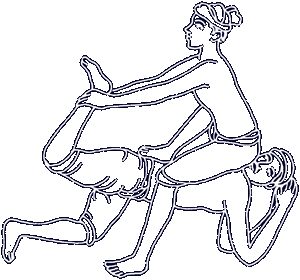
The history of Thai massage lies in
The
teachings and practices of Yoga date back at least 3,000 years (the Vedas and
Upanishads) and some findings date the origins even earlier. Folk legend
attributes the founding of this healing art to an Indian
doctor and contemporary of the Buddha named Jivaka
Kumar Bhaccha who is actually mentioned by name in
the Pali Canon (the scriptures of Theravada
Buddhism). The teachings of Jivaka Kumar Bhaccha, Buddhism and Ayurveda
spread throughout southeast Asia, reaching Siam (now Thailand) in what is
believed to be the 2nd or 3rd century BC.
Over
the centuries, spiritual teachings and healing techniques such as Thai massage
have mainly been passed down orally from teacher to student. More or less, the
present form of Thai massage has been practiced in
The
theoretical foundation of Thai massage lies in the concept that all of the life
at its most basic level is energy. This energy called “Prana”
in Sanskrit (Chi in Chinese) exists in many forms from the extremely gross to
the infinitely subtle and life is an interplay of these energies metaphorically
a cosmic dance of Shiva and Shakti, Yin and Yang, the
Sun and the Moon. Within the human body these energies flow along a network of
channels or lines (nadis or meridians). In the Yoga
tradition there are approximately 72,000 nadis. Each
has a specific function and energy that it deals with. The three main lines
energetically are the Sushumna (rising straight up
through the center of the spine) and the Ida and Pingkala
nadis which run on either side of the spine.
Health
in eastern philosophies is regarded as a state of balance between these
energies, where all the systems of the body, including mind and spirit,
function in harmony with each other. And disease (dis-ease)
is seen as imbalance or disharmony in this flow of energies. But beyond feeling
good physically an enlightened definition of health encompasses feelings of
vitality, strength, inner peace and joy.
Thai
Yoga Therapy is a deep healing and powerful combination of rhythmic massage, acu-pressure, deep stretching, gentle twisting, energy work
and meditation all rolled into one experience. This work
aims at stimulating the flow of healing energies within the body, opening the
areas which are blocked and bringing the body, mind and spirit back into
balance and harmony, for health, happiness and wellness of being.
http://www.thaiyoga.com
Task 1: Think about the following questions and then discuss them
with your partner or group.
1. What can you predict from reading the title of this text?
2. Have
you ever heard of Thai Yoga Therapy? How is it called in the Thai language?
3. Do you know anything about the history of Thai Yoga? Where did it originate?
4. In
your opinion, do you think Thai Yoga Therapy is as effective as modern
medicine? Why or why not?
Task 2:
Circle the
best answer.
- What is a “Chi”?
- a kang-fu fighting
- inner power
- a short word for a chiwawa
- a
Japanese food with rice and raw fish
- What is the concept of Thai massage?
- eating a lot and getting fat
- for the body to relax
- a way to make human being able to reach god
- making humans immortal
- The main idea of paragraph 6 is ______.
- The problem of Thai massage
- The roots of Thai massage
- How Thai massage has become popular
- The purpose of Thai massage
- The aim of Thai massage is to ______.
- relax the muscles
- heal the wound
- reduce stress
- stimulate the healing energies within the body
5. The passage tells us that Thai Yoga
Therapy __________.
a. originated 4,500 years ago
b.
is in conflict with modern medicine
c.
came from
d.
is called “nuad borarn”
in Thai
6. In “Nuad borarn”, the word “borarn” comes
from __________.
a. the Sanskrit root word “purana”
b.
the Portugese language
c.
the Chinese language
d.
the Pali root word “purana”
7. According to the passage, Buddhism and
Ayurveda spread throughout ________
, reaching
a. east Asia
b.
southeast Asia
c.
west
d.
northwest
Task 3: Write T in front of the correct statements and F in front
of the incorrect statement.
- ___ Stretching and medication help the body to
relax.
- ___ Every living thing
has an inner power (Chi).
- ___ Thai Yoga aims at stimulating the flow of
healing energies within
the body.
- ___ The teaching of Jivaka
Kumar Bhaccha ,Buddhism and Ayurveda
spread throughout
- ___ People fall ill because of the imbalance in
the flow of energies.
Task 4: Fill in the
blanks with suitable words.
1. Within the human body
these energies ____ along a network of lines.
2. Thai yoga Therapy is
powerful ____ of rhythmic massage.
3. Disease is seen as
imbalance or ____ in this flow of energies.
4. The word “purana” which means ancient or _____ body of work.
5. Folk legend ____ the
founding of this healing art to an Indian doctor.
6. Thai massage has mainly
been passed down ____ from teacher to student.
7. The teaching and ____ of Yoga date
back at least 3,000 years.
Task 5: Identifying References
What
do the italicized words refer to?
1. The word "its" (paragraph 1) refers to __________
2. The word "this healing art" (paragraph 2) refers to
__________
3. The word "each" (paragraph 4) refers to __________
4. The word "this" (paragraph 6) refers to __________
Extension
Task
Questions for Discussion
1. Do you think that Thai Yoga Therapy
should be considered as medicine? Give reasons to support your answer.
2. According to the passage, how does Thai massage work within the
human body?
3. Are there any other ways to treat diseases in the human body?
Give some examples to support your opinion?
Answer Key
Task 1
1.
History of Thai Massage and How Thai Massage works.
2.
Yes/No , Nuad Borarn.
3. In
4.
Yes/No , because........
Task 2
1. b
2. b
3. d
4. d
5. d
6. a
7. b
Task 3
1. T
2. T
3. T
4. F
5. T
Task 4
1. flow
2. combination
3. disharmony
4. sacred
5. attributes
6. orally
7. practices
Task 5
1.
Thai
massage
2.
Yoga
3.
a Nadi or a meridian
4.
Thai
Yoga therapy
Contributed by
Kannikar Weeramathachai
Ketsara Meesukanan
Waraporn Yingyoud
Apagorn Aumpaisumpunthakul
Editor : Antikar Rongsa-ard
WORD LIST
Theoretical (adj.) = based
on theory rather than experience.
Energy (n.) = force,
vigor, capacity for activity.
Gross (adj.) = overfed,
repulsively fat.
Subtle (adj.) = evasive or
mysterious; hard to grasp
Interplay (n.) = the
operation of two things on each other.
Flow (v.) = glide along
as a stream.
Tradition (n.) = a custom,
opinion, or belief handed down to posterity
Spine (n.) = a series of
vertebrae extending from the skull to the
small of the back; the backbone.
Regard (v.) = give heed
to; take into account
Harmony (n.) = a
combination of simultaneously sounded
Enlighten (v.) = instruct or
inform.
Definition (n.) = the act or
process of defining.
Encompass (v.) = surround or
farm a circle about, esp.
Vitality (n.) = the ability
to sustain life.
Strength (n.) = the state
of being strong; the degree to which.
Inner (adj.) = further in , inside, interior the inner
compartment.
Combination (n.) = the act or
an instance of combining, the process of
being combined.
Rhythmic (adj.) = relating to
or characterized by rhythm.
Stretch (v.) = draw or be
drawn or admit of being drawn out into
greater length or size.
Gentle (adj.) = mild or
kind in temperament.
Meditate (v.) = exercise
the mind in contemplations
Spiritual (adj.)
= concerned with sacred or religious thing
Sacred (adj.) = connected
with religion
Vedas (n.) = the most
ancient Hindu scriptures
Upanishads (n.) = each of a
series of philosophical compositions concluding
the exposition of the Vedas
Attributes (n.) = regard as
the effect
Contemporary (adj.) = living
or occurring at the same time
Oral (adj.)
= by word of
mouth; spoken; not written
Healing (adj.)
=
become sound or healthy again
Traces (v.) = observe,
discover
Theoretical (adj.) = concerned
with knowledge but not with its practical
application
Interplay (n.) = reciprocal
action
Philosophies (n.) = the use of
reason and argument in seeking truth and
knowledge of reality